

Advanced therapy dog skills are the difference between a good visit and a truly unforgettable one. Basic certification gives you and your dog the foundation to enter clinical settings safely. But the handlers who build the deepest connections with patients go further. They teach their dogs to respond to fragile environments, adapt to unpredictable equipment, and bring moments of pure joy to people who need it most. This guide is written for therapy dog handlers and program coordinators who are ready to move past the basics and build a team that makes real impact.
What Advanced Skills Really Mean
Advanced therapy dog skills are not about performing circus tricks. They are about reliability, calm, and connection in high-stress environments. A dog who can shake paws on command brings a smile. A dog who can hold still on a bed next to a patient with an IV drip brings comfort that medication cannot.
At TheraPetic®, our clinical team has observed across years of program coordination that dogs with expanded skill sets visit longer, return more often, and generate stronger therapeutic outcomes for patients. Our volunteer handlers consistently report that learning advanced techniques also deepens their own sense of purpose in the program.
Advanced certification programs vary by organization. Many therapy dog registries offer a second tier or advanced evaluator credential. Before pursuing any advanced training, confirm that your dog has a clean record of basic-level visits with no stress signals, handler corrections in the field, or incident reports.
Tricks That Delight Patients
The right trick at the right moment can cut through pain, fear, and loneliness in seconds. Three skills stand above the rest in clinical and care environments.
Paw Shake
Paw shake is the single most requested behavior in hospital and memory care settings. Teach it cleanly so that your dog offers a paw gently, without scratching or jumping. Practice on flat surfaces, raised bed heights, and on a human lap. The behavior should come from a verbal cue alone, with no leaning or shifting weight forward.
Gentle Take
Gentle take teaches your dog to accept an item from a patient's hand with a soft mouth. This skill is transformative with pediatric patients and those with occupational therapy goals. Patients who struggle with grip strength find enormous motivation when they can hand a toy or biscuit to a dog. Work with your handler mentor to ensure the release cue is equally reliable.
Chin Rest
Chin rest, sometimes called "lap nose," teaches your dog to rest their chin on a surface or a patient's leg on cue. This calm, still behavior is one of the most soothing physical contacts a therapy dog can offer. It requires duration training. Start with a two-second hold and build slowly to thirty seconds or more.
Lap Visits and Gentle Contact
Lap visits are when a therapy dog is lifted or invited onto a chair, wheelchair, or bed to rest partially against a patient. Not every dog is suited for this. Size, body awareness, and temperament all factor in. A dog who is wiggly, mouthy, or unpredictable with pressure is not a candidate.
For dogs who qualify, lap visits require specific conditioning. Practice the weight shift of being lifted and placed. Practice being settled on a surface at bed height with movement happening around them. Practice staying relaxed when a patient's hands move unexpectedly or when a blanket is pulled over part of the dog's body.
Always follow facility protocols for lap visits. Some hospitals restrict dogs from patient beds entirely. Others welcome them with handler supervision. Know the policy before every visit and check in at the nursing station if the patient's condition has changed since your last visit.
Lap contact guidelines are often covered in detail during therapy dog team training. If you are new to this skill set, explore our therapy dog team training resources to understand what structured preparation looks like before your first bedside visit.
Navigating IV Poles, Tubes, and Medical Equipment
A dog who freezes at the sight of an IV pole is not ready for hospital work. A dog who bumps into a catheter line or steps on oxygen tubing can cause real harm. Equipment navigation is one of the most underemphasized skills in advanced therapy dog preparation.
Start desensitization at home. Set up mock equipment: a rolling coat rack, garden hoses draped on the floor, a folding chair placed unpredictably in the path. Walk your dog through this environment slowly and reward calm, deliberate movement. The goal is a dog who notices equipment, checks in with you, and moves around it without hesitation or anxiety.
In actual hospital rooms, keep your dog on a short four-foot leash during navigation. Scan the room before you enter. Identify line placement, call bell cords, oxygen tubing, and any floor-level hazards. Position yourself between your dog and the equipment whenever possible. Move in slow arcs, not straight lines, when the room is tight.
Nursing staff are your best allies here. Introduce yourself, ask if any lines are at floor level, and thank them after every visit. Building relationships with clinical staff makes your visits smoother and keeps your program welcome in the facility long-term.
Working with Bedridden Patients
Bedridden patients present a unique set of conditions. The patient cannot come to the dog. The dog must come to the patient, and often must perform at an unusual height, in a confined space, with minimal room to reposition.
Height training is essential. Your dog should be comfortable performing behaviors on a raised platform that mirrors a hospital bed height. Use a grooming table, a sturdy bench, or a purpose-built platform during conditioning. Practice paw shake, chin rest, and gentle take from this elevation so the skills transfer cleanly in the room.
Bedridden patients may move slowly, speak softly, or not speak at all. Train your dog to hold behaviors for longer durations in low-stimulation environments. A dog who is used to quick, reward-heavy interactions may get anxious or start offering behaviors randomly when the feedback loop slows down. Duration work during training prevents this.
Watch your dog's stress signals throughout every bedridden visit. Yawning, lip licking, looking away, and a tucked tail are all signs that your dog needs a reset. Step out of the room, let your dog shake off, and offer water. A short visit done calmly is worth more than a long visit with a stressed dog.
Multi-Handler Visits and Team Coordination
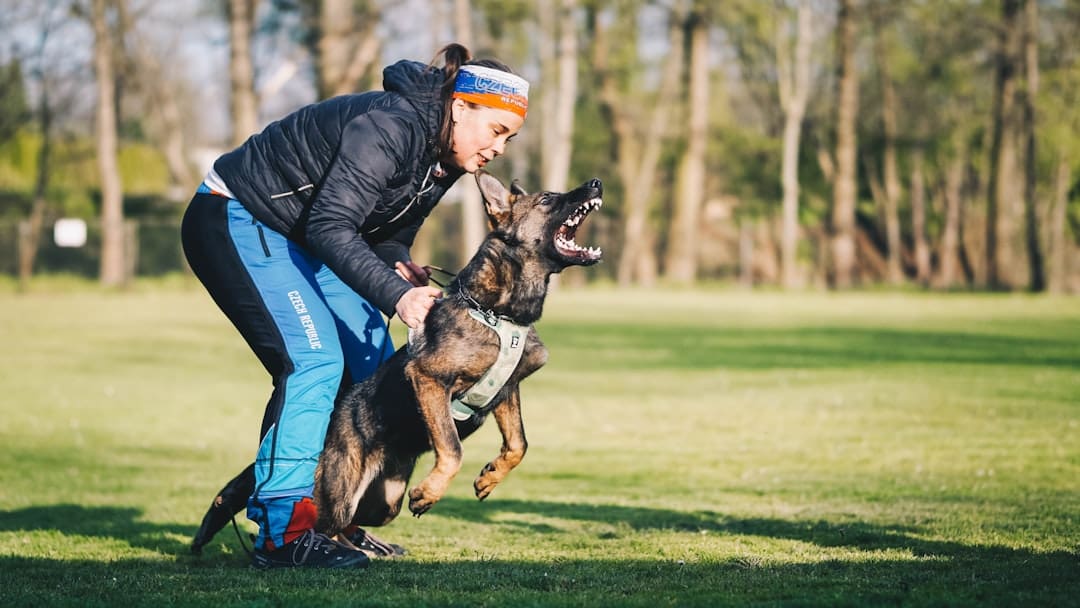
Multi-handler visits happen when two or more therapy dog teams visit a facility together. This format is common in school reading programs, disaster response deployments, and large facility open visits. The coordination required is different from solo visits and is worth practicing deliberately.
Dog-to-Dog Introductions
Not every therapy dog enjoys the company of other dogs. Before any multi-handler visit, introduce the dogs in a neutral outdoor space. Observe body language for two to three minutes. If either dog is stiff, fixated, or showing any resource guarding behavior, they should not work in the same room simultaneously.
Traffic Management
In hallways and common areas, two teams moving together can feel crowded to patients and staff. Use a staggered approach: one team at the patient's side, one team waiting outside the door or at the end of the hall. Rotate every ten to fifteen minutes. This gives each dog a mental break and prevents over-stimulation for sensitive patients.
Handler Communication
Establish a shared vocabulary before the visit. Agree on hand signals for "let's move on," "my dog needs a break," and "check in with me." Quiet, clear communication between handlers prevents confusion and keeps the visit feeling smooth and professional to the facility staff observing you.
Program coordinators can find structured guidance on visit protocols and team coordination through our facility visits program page. Building a coordinated volunteer team takes time, but the results for patients are worth every practice session.
Keeping Your Dog Sharp Between Visits
Advanced therapy dog skills fade without regular reinforcement. A dog who visits once a month and does no training in between will lose sharpness in duration behaviors, equipment navigation, and complex cues. Plan for two or three short practice sessions each week between visits.
Use real-world environments for practice whenever possible. Ask a friend to use a rolling suitcase as a mock IV pole. Practice in a coffee shop or library to maintain calm behavior in public. Work on paw shake and gentle take with family members of different ages and physical abilities.
Joining a local handler study group or mentorship circle is one of the most effective ways to stay sharp. Experienced handlers share scenarios you would not think of on your own. New handlers bring fresh perspective. If your program does not have a study group, ask your program coordinator about starting one. TheraPetic® supports volunteer community-building as part of our nonprofit mission to expand access to animal-assisted support across underserved populations.
You can also revisit foundational concepts through our handler screening and preparation resources. Even experienced handlers benefit from returning to core principles once or twice a year.
Your Next Step as a Therapy Dog Team
Advanced therapy dog skills are built slowly and practiced consistently. You do not need to master every technique in this guide before your next visit. Pick one area, work on it deliberately for four to six weeks, and then evaluate how your dog performs in the field before adding the next skill.
The patients and residents who benefit from your visits are counting on you to show up prepared, calm, and confident. Your dog reads your energy. When you are grounded and skilled, your dog is too. That combination is what creates the moments that patients remember long after you leave the room.
TheraPetic® is a 501(c)(3) nonprofit healthcare provider group dedicated to supporting therapy dog volunteer teams with training resources, clinical guidance, and program coordination tools. Our mission is to make high-quality animal-assisted visits accessible to more patients in more communities. To learn how TheraPetic® can support your team's development, visit go.mypsd.org or call us at (800) 851-4390.
For more information on federal guidance related to animal-assisted activities in healthcare settings, the Centers for Disease Control and Prevention publishes current infection control guidelines for animals in healthcare facilities that every handler should review before visiting a clinical setting.
Written By
Ryan Gaughan, BA, CSDT #6202 — Executive Director
TheraPetic® Healthcare Provider Group • About • LinkedIn • ryanjgaughan.com
Clinically Reviewed By
Dr. Patrick Fisher, PhD, NCC — Founder & Clinical Director • The Service Animal Expert™
Editorial Review
This article was reviewed by Dr. Patrick Fisher, PhD, NCC on July 19, 2026 for accuracy, currency, and clarity. Content is updated when laws or guidance change.